Monday, October 31, 2011

Living life on Facebook

Jim woke up on a lazy Saturday morning and gazed over his bedroom. He saw a large photo hanging next to the window frame. On the photo were roughly twenty-five post-it notes with nothing but the word “like” occupying the entire piece of paper. On the back of the post-it notes were the names of Jim’s friend who have submitted it. The post-it notes were arranged in an alphabetically order across the photo. The photo itself was simply a shot of Jim dressed up as “the money you could be saving with Geico” for Halloween (see picture below for clarification.) But due to the numerous post-it notes, only a quarter of Jim’s face was visible.

The Money You Could be Saving with Geico (Jim's Halloween costume.)

Jim then preceded to his regular morning routines. Upon completion, Jim headed out the door. As he descended the doorsteps, a small piece of wrapped paper fell from the sky and onto Jim’s hand. Jim immediately unfolded the paper. There was only one line of text and it reads “Sam Johnson commented on your wall post.” Moment after reading, four more wrapped paper emerged from thin air and fell on Jim. Unfortunately, both of Jim’s hands were occupied from holding the first paper, so the newly appeared papers fell by Jim’s feet. As Jim reached down to grab them, Jim suddenly felt a light force was exerted on his back. He used his right hand to feel for any changes to his back. Unexpectedly, Jim’s hand was touching a photo that was “tagged” on him. Jim took the photo and found out that it was a picture of his friend and he dressed in his Geico costume. Seconds later, Jim saw that his friend Gabriel crossed the street and stood by Jim’s side. Gabriel lifted his right index finger, and, with a small amount of vigor, trusted the finger into Jim’s arm while simultaneously yelling out “POOOKE!” Jim was not sure how to respond to Gabriel’s action and chose to ignore it. Jim’s Farmville friend Mike then made an appearance with a pink cow three times his size beside him. It appeared Mike has found a wandering cow in his farm and he wanted Jim to take care of it. In the midst of this chaos, Jim’s classmate Sophia came up to Jim and said: “Hi, I want to be your friend. Do you accept, ignore, or decline?” Having freaked out, Jim turned around and tried to retreat back to his house only to discover that his other friend Gary was using a can of spray can to write some sort of message on his wall. Through the windows, Jim discovered that his boss is looking through his photo albums. Photos of Jim’s partying nights. Jim was now scared. He was frightened on what would occur next. He yelled and screamed as loud as he can to the sky: “What in the world is happening!!!” As if the God has answered his prayer, all of his surrounding turned black. His friends, the pink cow, the pieces of paper, and even Jim’s wall and house disappeared. At last Jim was at point blank. Nothing but darkness surrounded him. Finally, ‘BLEEP’, Jim disappeared as well as the computer shuts down.

You have just lived a moment of Jim’s life on Facebook. You can say Jim was one of those people who, as Rosenberg described, “put[s] everything out there.” Before Jim was sucked into that unusual world, he was posting inappropriate photos on his Facebook profile. This is why he became scared after finding out his boss has been peeking into his pictures.

Sunday, October 23, 2011

Ways to laugh

            Laughing is such an enjoyable activity. I mean why else would villains in superhero movies burst out laughing when their doom is near? To enjoy their last moment of course! OK I was joking about that. Genuinely laughing is the most sincere form of amusement.  Laughing is such a great activity that it has gained a large variety on the internet! Let me cite all the variants I can think of:

  • lol: stands for Laugh out Loud. Everyone knows about this, let's carry on.
  • lololololololol: For added emphasis on lol. This does not literally mean laugh out loud out loud out loud … but rather, it means several lol's in a row. This is also a great way to laugh in real life! Using lololololol (I pronounced it loh-loh-loh-loh-loh) to laugh will surely result in your friends laughing with you! And no, I don't mean laughing at you.
  • lulz: A variant to lol
  • lolwut: The fusion of lol and what. Are typically used in funny, confused situations
  • trolololol: The combination of trolling and lolling. Indicates a prank has been made.
  • lmao: Stands for Laugh My Ass Off. It doesn't actually mean your ass is detached from your body as a result of laughing for those who are wondering. It just means you laugh off of your seat.
  • rofl: Roll on Floor Laughing, pretty self-explanatory
  • roflmao: Combination of rofl and lmao, for added emphasis.
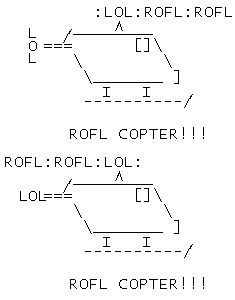
  • roflcopter: The union of rofl and helicopter. Was rumored to originate from a forum moderator on Warcraft III.
  •  lollerskate: The union of roller-skate and lol. Internet users are so imaginative aren't they?
            Laughing is such a great way to bond with both your offline and online friends. Similar to what Barlow stated on her book Blogging America, writers need the presence of a supporting audience to help them write better. You become that supporting audience if you send a simple 'lol' when one of your friends tells a joke. Showing your friends that you support them will surely aid in sustaining friendships.

Sunday, October 16, 2011

Of Surfers and Spiders


The term "surfing the web" is a common terminology used when one searches the internet. But how did one relate surfing tides to browsing the web? Is spiders fond of water sports? The spider part is not completely impossible. When I was about five and living in China, I personally have the experience of spiders trying to share a bath with me. A spider about the size of an adult palm (damn healthy Chinese foods overgrowing these spiders!) dropped from the ceiling of the bathroom and made a splash on my bathtub while I was taking a bath in the evening. Oops! I seem to have gone astray from the topic.

Anyway, the terminology of "surfing the web" or "surfing the internet" originate from a librarian, called Jean Polly. Polly was an early internet user who wrote a series of articles online. In June 1992, she published a paper about technical writings done on the internet. For the title of the paper, she wants to use a metaphor that's expressed the fun of the internet. She wants something that would evoke a sense of randomness, chaos, and even danger. At the time, Polly was using a mouse pad from a library that's famous for printing pithy sayings on sportswear and mouse pads. Coincidentally, Polly was using a mouse pad that has a picture of a surfer on a big wave with the words "Information Surfer" underneath. Eureka, Polly got her metaphor. She published a paper titled "Surfing the Internet" that was remarkably successful. The paper achieved 500 downloads in 14 hours. That was a lot back when the internet wasn't very popular.

In one of the readings I made in English class, I stumble upon the idea that a good and supporting audience encourages the writer to publish more works (B. F. Skinner). Polly experienced a similar scenario. Her paper "Surfing the Internet" attracted such a large audience that Polly tries to better the paper. She updated and corrected her paper on May 1993. The revised paper is able to gain an even higher popularity than her old one. The term "surfing" is now gaining acceptance and have been used on several other medias such as the New York Times, the Washing Post, the Wall Street Journal. Up to the present, this term still remains popular as we are all still using it.

Monday, October 10, 2011

Why is the web called the web?

This question has to be addressed eventually considering how my blog is titled “Words Caught in the Web.” We all know that the internet and the web are similar. So why not just use the word internet all together? It’s relatively easy to see why the internet is called the internet. The prefix of internet, inter- means in between or among. The net from internet simply means network. So internet means the communication or connection between various networks, but what about the word ‘web’? What’s the relationship between the word web and the internet?

When we see or think of the word ‘web.’ We think of the internet or spider webs. Spider webs are composed of several straight segments of threads and are connected throughout with a more circular thread. To further help you imagine the illustration; I provided a picture of a spider web with, as a bonus, a live spider in the middle. I certainly hope there’s no one with arachnophobia in the audience.

 http://www.webzrule.com/spider053/spider+web.jpg

The spider web shows a resemblance to the notion of connectivity in one of the readings I made in class called “Growing up Tethered.” Parents give cell phones to their kids because the parents will be able to reach or ‘connect’ to their children at anytime they want. The children want a cell phone because they can connect to their friends. So in a way, we’re all like the threads of a spider web, connected through electronic communications.

With this depiction of a spider web in mind, it can be easier to see how the web is related to the internet. Many people, like this fellow blogger, think that the web is called so because the web, like how the spider web is connected threads, connects numerous links and websites. Well, they are correct. In fact, one of the original reasons for the development of the internet and the World Wide Web was for diverse researchers all over the globe to web their researches together. Hence, the term ‘web’ is used.

Thursday, October 6, 2011

Origin of Java


Java is obviously a very popular brand name.  It’s far more well-known than its distributor Sun Microsystems. But where did this name come from? Surely it has nothing to do with programming languages, nor is it an acronym of any sort to represent the programming language Java.

As weird as it may sound, Java was originally called Oak, named after an oak tree that stands outside one of the creator’s office. But after finding out that Oak Technology (a supplier of chips for sound/graphic card) had trademarked that name, a brain storming session was held to determine a new name for what is now known as Java. All members of what was then called ‘Live Oak’ (members that was working on the language) attended.

The session was nothing but organized. People were screaming and yelling out any words that appeal to them. It’s rumored that half the dictionary was yell out at one point or another. This entire wild and craziness is similar to how the internet was when Justin Hall first started using it. Like the brainstorming session, there were no restrictions or regulations that determine what is appropriate and what is forbidden to say on the internet.

WebDancer, WebSpinner, Ruby, WRL, for WebRunner Language, Pepper, NetProse, Neon, Silk, DNA and finally Java (from Peet’s Java) are among the many words that were uttered in the meeting. Ten finalists were selected and sent to the attorney office for approval. Three came back clean. They are DNA, Silk, and of course, Java. A final vote is held. Every member of the meeting is to rank the three names by their preference. The name Silk received the most “most-favorite” votes but also received the most “least-favor” vote. Silk was dropped as a result. Between DNA and Java, Java was crowned champion.

Will Java gain the popularity it had today if it went by a different name? Who knows. Will it sound weird if Java is still called Oak? Oh yes, definitely.